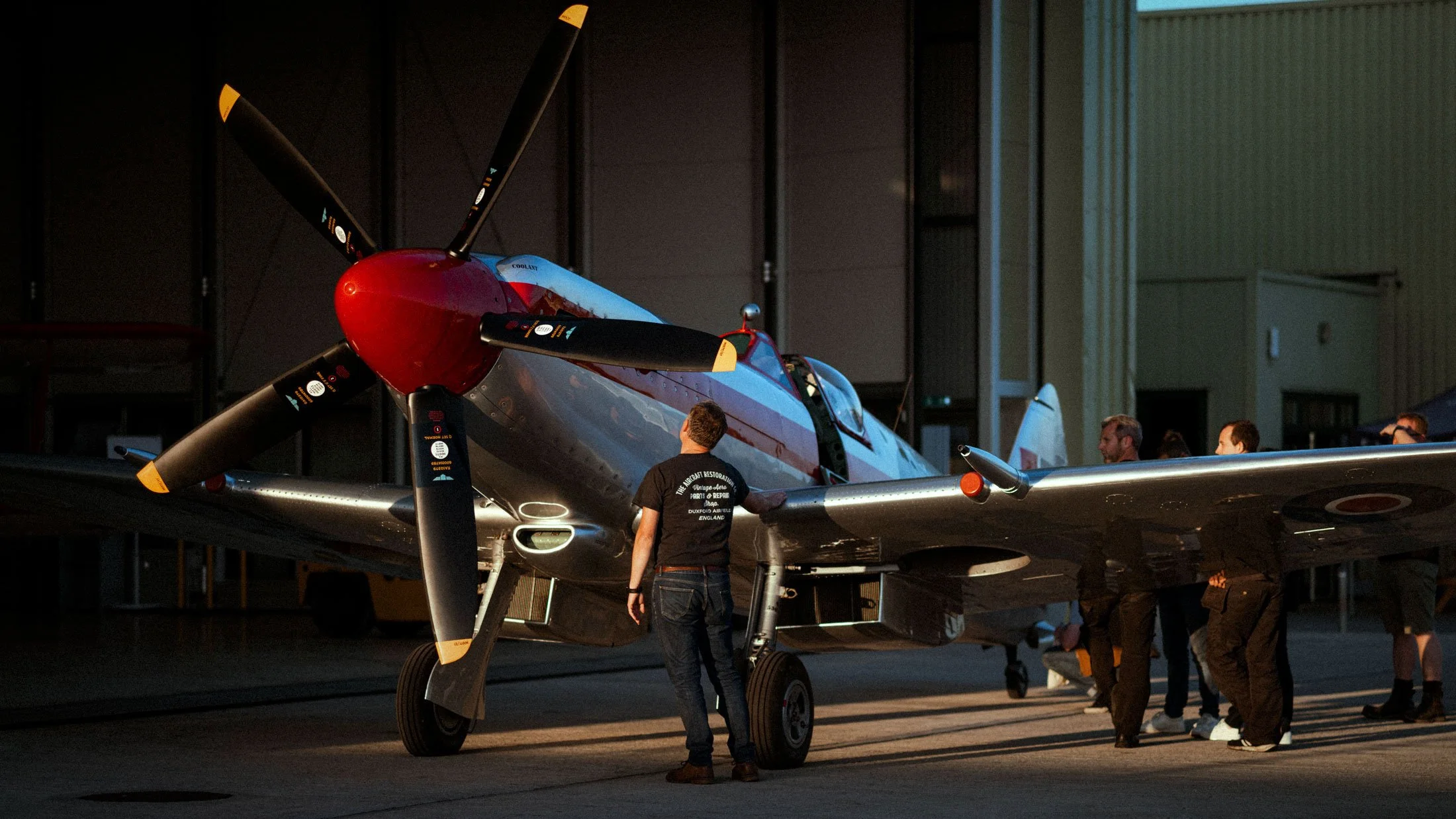
News:Historic Flying initiates replica flight sim model programme Pilots can test and hone their warbird flying skills with a unique new flight simulator package that replicates the rare Spitfire T9 being restored by Historic Flying of Duxford. The new warbird flight simulator is being developed in an industry-first partnership between Historic Flying and one of the top flightsim developers, Aeroplane Heaven. It will be available for download as an add-on to current Microsoft Flight Simulator packages. Virtually all commercial flight simulator packages replicate 'generic' aircraft or aircraft that are not accessible to general aviation pilots. This new partnership has been established to generate accurate virtual replicas of real aircraft that pilots could experience for themselves. John Romain of Historic Flying said: "This simulator will help us acclimatise warbird pilots to the flying environment of the Spitfire. Familiarity with the controls and the attitude of the aircraft will help to produce better and safer pilots - and for those who haven't managed stick time in a Spitfire, it'll give them a real taste for it." The model is based on Aeroplane Heaven's proven generic models of the Spitfire Mark IX and from original documents, drawings and contemporary photographs of the actual aircraft. Every instrument, control and marking is authentic to help make it as 'real' an experience as possible. Its flying characteristics will be validated against the real aircraft by experienced pilots with the help of a high-integrity flight data recorder system being installed in the aircraft. Barry Bromley of Aeroplane Heaven said: "This will be one of the most accurate models of the Spitfire yet created; the amount of detail we've had to work with has been second to none. Pilots will find it a great help in feeling at home in the Spitfire should they be fortunate enough to fly Historic Flying's two-seater for real." The subject aircraft, IAC-161, served with the Irish Air Corps during the fifties and sixties. It was originally built as Spitfire LF IX PV202, fitted with a Rolls Royce Merlin 66. The aircraft saw action in 1944 and 1945 and was credited with 'kills' in service with the Royal Canadian Air Force. It was converted to two-seater specification before being delivered to the Irish Air Corps. IAC 161's total restoration to original condition, including the 'large' rear bubble cockpit, is almost complete with the first flight expected shortly. Aeroplane Heaven's catalogue of flight simulator add-ons can be found at www.aeroplaneheaven.com. The new Spitfire T9 model will be available shortly after the first flight of the real aircraft.
IAC-161 set for Spring 2004 first flight HFL's current restoration project, its Mk T9 two-seater Spitfire IAC-161, is making good progress. Its first flight after a total rebuild is expected in late February or early March 2004. It is almost ready to rest on its wheels, with both wings in place and cockpit systems being installed. Its freshly-built Merlin 66, overhauled by Universal Airmotive of Chicago, will be installed shortly. When airworthy, IAC-161 will go into service with HFL and sister company Aircraft Restoration Company (ARC) as the final rung in the ladder of a unique warbird pilot training programme developed by ARC. John Romain of HFL said: "For some time we've been working towards setting up the world's finest warbird pilot training programme. Flying a high-performance and rare warbird such as a Spitfire is a tremendous privilege and hugely rewarding, accessible to only a few. It demands good training and progressive conversion to minimise risk and maximise the rewards. When IAC-161 joins the flightline we will be able to take 100-hour PPL's through tailwheel conversion on our Chipmunk into complex and high-performance aircraft with our Harvard. The next and vital step on the way to soloing a Spitfire has been almost impossible before this - time in our dual-control Spitfire." All training will be carried out by instructors working to military standards of performance, which will stand their students in good stead whether in a warbird or a modern aircraft. IAC-161 is being fitted with a digital data acquisition system from Pi Research for monitoring aircraft performance and recording flight data. The system can also record video from each flight, with feeds from three miniature cameras on board. The video will be used for passenger mementoes and training purposes.
Rare Spitfire sold overseas to private buyer
Origin of MK912 First Flight RN201 took to the air for the first time after rebuild on 24 April 2002, before the completion of the paint scheme (see picture below). The livery is similar to that of TD248, also operated by HFL. Data recorder system HFL is working with Pi Research of Cambridge, world leaders in digital data acquisition systems, to develop a compact flight data recorder system. RN201 has been fitted with a prototype system, (see picture) installed in the rear fuselage.
HFL believes that this is potentially a very exciting
development for the warbird industry. Pi’s system can provide in-flight
monitoring, aircraft health monitoring, trend monitoring and post-flight
performance data. It could be a real boon to pilots and owners, acting as
a virtual flight engineer by providing high-quality data and analysis of
the aircraft’s vital signs. Pi Research and HFL see several possible benefits for the new system, including:
One application specific to the warbird industry is that
the first system will have a prototype carbon dioxide (CO2) sensor fitted
to monitor cabin air quality. Information needed HFL is beginning the restoration of a two-seat Spitfire T9 which served with the Irish Air Corps as IAC-161 in the 1950's. We would welcome any information on the aircraft's operational colour scheme, preferably in the form of colour pictures of this or its sister aircraft from that time. HFL is also searching for a Griffon header tank in serviceable condition. If you have any relevant information, please contact us - we would be delighted to hear from you.
|
||